Google’s $500B Drop: What AI Search Means for Your Website Traffic
What does Google’s $500bn drop mean for your content and website traffic?
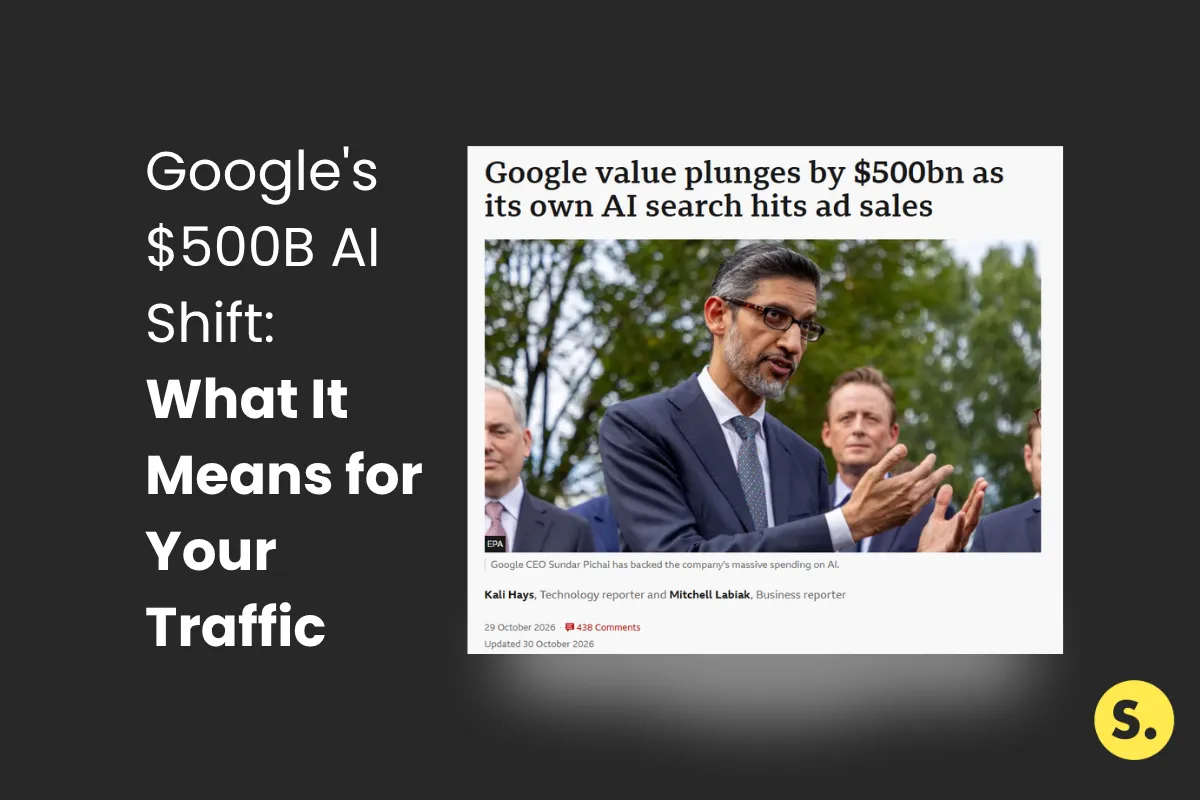
The short answer is that for most small businesses the effect on your own traffic looks small so far, though it’s well worth checking your numbers. On Thursday 29 October 2026, Alphabet (Google’s parent company) lost just over $500bn (£374bn) in value after telling investors that the AI answers at the top of search are affecting how many ads it can sell. Here’s what happened, what two Google Ads specialists are seeing, and the 4 things I’d look at in your own numbers this week (as of 5 November 2026).
What happened to Google?
Kali Hays reported for BBC News that Alphabet lost just over $500bn (£374bn) in value in a day, after telling investors that AI answers at the top of search are affecting its ad sales. When Google first started putting AI answers at the top of search, I wondered whether our blogs and indexable articles (like LinkedIn’s or Substack) would get pushed down the page and whether anyone would still click through... and now Google has told its investors it’s feeling the effect too. (I can hear the echo of ‘I told you so’ from marketers everywhere! 😆)
Search revenue still grew 12% and search queries are growing faster than they have in five years, according to Alphabet’s Q3 results, though Google’s explanation, reported by CNBC, is that it earns less from each AI Mode search... for now.
$500bn sounds enormous to most of us, and at almost 13% of Google’s value it’s enough to rattle investors (not a surprise!!) without being enough to change direction- at least yet! Alphabet is spending so much on AI (as are all the big AI players) that its free cash flow went negative by more than $9bn this quarter, so I can’t see them stepping back, but my guess is we’ll see a change in how AI search is presented. On the earnings side, Google said it’s scaling ads within AI Overviews and AI Mode to more users and queries, according to TechCrunch, so it seems they want to prioritise the profitability of AI before they consider pivoting.
Is Google removing AI summaries from search?
You might have seen posts saying Google is removing AI summaries from search... but I couldn’t find anything confirming that, and the data I found actually points the other way, with Google adding ads inside them.
Do people trust the AI answers they’re getting?
From the reaction I scrolled through to other posts sharing this story, a lot of people don’t, and 2 things kept coming up: people don’t trust the AI answers they’re getting, and people who think more ads will put them off using that search tool.
The first one is the one I’d watch most closely, because the more AI-written content goes out, the more AI answers get built from other AI content, so the facts can end up being whatever got repeated most, which may or may not be what’s true. That means the loudest voices in the room, which might be AI, are the ones that get repeated, and the researched, truthful voices can get drowned out... which is a worry for all of us, business owners and humans alike!
So even more fact checking is needed, and ignoring the summary and looking directly at the sites might be a more accurate way to use it. And of course, you can switch to a search engine like DuckDuckGo, which has a no AI option.
What are small businesses seeing?
I asked 2 friends who work in Google Ads what they’re seeing, and the short version is that AI shows up in their data, but it’s small.
Selena Durrant of Adelie Creative manages Google Ads for small businesses, and she said:
‘I haven’t seen a drop in ad spend or clicks that I could put down to AI search. But when performance has dipped, it’s been down to things like website issues or tracking. AI is showing up in the data, but it’s small. One client had 4 visits from ChatGPT in a month, compared with over 300 from Google search and ads combined.’
And Krystal from Krystal Designs said:
‘I’m seeing the same as Selena: AI search is a small slice of the traffic for most small businesses. But it’s often the first thing people read about you, before they click your ad or your website. And the AI can only repeat what it finds. When we checked our own business, our Google profile still told people we were open 24/7. We’re open Monday to Friday, 9 to 5. That’s the first thing I’d check.’
So at Google’s scale it’s showing up in the ad sales, and for small businesses it’s showing up in the data but it’s small. It also helps to know that a Pew Research Center study of 900 US adults’ browsing in March 2025 found people clicked a regular search result in 8% of visits when an AI summary appeared, compared with 15% when there wasn’t one, which is one reason impressions and clicks can drift apart.
What does it mean for free traffic from Google to your website?
I haven’t seen so much recent data on this, which is my side of things. The closest I’ve found is from Chartbeat, which tracks news and media sites, and it says Google Search referrals to publishers fell 40.2% in the year to July 2026, so it’s worth checking whether you’re seeing the same. Chartbeat’s network skews towards news and media publishers, so I wouldn’t assume a small business site will see the same drop. The same report shows direct visits making up a bigger share of pageviews, 15.9% in July 2026 against 13.5% in July 2024, which is a good reason to build an audience that comes to you directly.
What should you check in your own numbers this week?
There are 4 things I’d look at, and none of them need a paid tool:
⭐ Google Search Console- compare impressions with clicks on your key pages over the last few months. If impressions are steady and clicks are dipping, people may be seeing you without visiting.
⭐ Search the topics you want to be known for and see whether an AI answer appears, and whether your site gets mentioned in it. I’ve written more about checking this in my post on [how to get AI to recommend your business](link once it’s live).
⭐ Look at how many visits come from people who already know you- your email list and direct visits in GA4, and searches for your name in Search Console.
⭐ Selena’s checklist for showing up in AI search- are you on social media, is your Google Business Profile up to date (opening hours included, as Krystal found!), is your website easy to navigate, and are you on top of your SEO?
Are we near the peak of AI search?
I don’t think AI is going away anytime soon, but I do wonder whether we’re near the peak and it’s about to split into the companies that make it and the ones that don’t. I’m only going on what I can see so far, so what are you seeing in your own numbers? If you’d like help making sense of them, pop me a message... I’d love to hear what you’re working on. 🙂
Sources: BBC News (Kali Hays), CNBC, Alphabet Q3 2026 results, TechCrunch, Search Engine Journal on Chartbeat’s 2026 Publisher Playbook, Pew Research Center, and personal conversations with Selena Durrant and Krystal Blackwell.
