Identifying Your Ideal Client in Social Media Marketing. (And why it changes everything.)
Deciphering who your ideal client is is crucial in your social media marketing... you really can't do effective marketing if you don't know who you're talking to.
It's about knowing who you're speaking to, what resonates with them, and how your brand fits into their world.
And not just demographic data (like age, where they live, and so on). It's about looking deep into the psychographics of your audience- their interests, behaviours, and preferences. How do they actually feel about their demographic? That’s often the missing piece.
Let’s start with an example:
…their demographic is age 60-65, but their psychographics might be that they don't feel it. They are young at heart; they work out at the gym and love that their kids are grown up and they have the freedom for adventure.
Or they feel old, they're tired, worn out, and feel invisible to the younger generation. They're sad that their kids are no longer at home and are missing a purpose in life.
Same demographic. Totally different psychographics.
And how you would market to those two different 60-year-olds would change your approach totally.
Figuring out your audience is like the compass that guides your content strategy, making sure that what you post is not only seen, but felt and acted upon by your audience.
Generational markers- the layer most people skip.
Demographics and psychographics give you a strong foundation, but there's a third layer that's well worth adding... generational markers. This is about recognising that your ideal client, like all of us, has been shaped by the era they grew up in- the technology they had access to, the cultural moments they lived through, the values their generation collectively formed. These experiences run deep, and they influence how people communicate, what they trust, and what kind of content actually resonates with them.
Of course, these are broader generalisations and there are always exceptions- but as a layer to add to your ICA work, it can make a real difference to how you think about tone, cultural references, and communication style.
Baby Boomers (born 1946-1964) are often characterised by brand loyalty and a preference for content that feels trustworthy and established. They tend to have more significant disposable income than later generations, and while many are active on social media, platforms like Facebook- where they can connect with friends and family- tend to be a more natural fit. Content that appeals to their sense of community, quality, and customer service excellence can be particularly effective.
Gen X (born 1965-1980) are known for their independence and a healthy scepticism of overt marketing- they're the generation that largely raised themselves, the first of the latch-key kids. They appreciate content that feels authentic and practical rather than performative. Facebook and LinkedIn are popular among this group, though there are some brilliant Gen X creators on TikTok! (Have you seen the Gen X/Gen Y wars on there?! They do not hold back. 😆)

Xennials (born approx 1977-1983- it's not totally clear cut!) Hello 👋)) are what I call the 'magic generation'... and that's also where I fit, so I may be biased! Though I'm personally backing Jay's suggestion that we just call ourselves the Goonies. We grew up in an analogue world- walking to the phone box, four channels on the TV- but adapted to digital technology as adults, getting on Facebook when it first launched, which gives us a fairly unique perspective on both. Xennials tend to value personal connection and technological convenience in equal measure, and engage well with content that blends both depth and accessibility.
Millennials (born 1981-1996) are digital natives who value experiences over possessions and tend to prioritise social responsibility. They're active across a wide range of platforms and respond well to content that is visually appealing, interactive, and reflects a genuine commitment to values- sustainability, inclusivity, and authenticity tend to land well here.
Generation Z (born 1997-2012) are the first truly digital-native generation, with a significant portion of their lives lived entirely online- and now, with AI as a given rather than a novelty. They prefer short, dynamic content and are quick to embrace new platforms and tools. They also have a well-documented ability to spot anything that feels inauthentic from a considerable distance. 😬
Integrating these generational insights into your ideal client avatar work can refine your approach considerably. Going back to that 60-65-year-old demographic example…
understanding whether they identify more with Baby Boomer or Gen X tendencies changes your tone, your cultural references, and the platforms you prioritise. It can also be a lot of fun... cultural references that work perfectly with one generation will mean absolutely nothing to another … The Goonies reference, for the record, works great on Xennials and almost nowhere else. 🙂!
When you do the work on your ideal client avatar, your content is more likely to be received well by those people as they see themselves in it, or feel a connection to it- and you increase the chances of your engagement going in the right direction too.
Engagement isn't just likes and shares though; it's meaningful interactions that build relationships. These relationships eventually translate into brand loyalty, repeat business, and client referrals. Around 44% of internet users aged 16 to 64 consider social media as their primary source of information when researching products, and a significant 76% of users make buying decisions based on what they discover on social media... so it really is worth putting in the effort to get your ideal client avatar defined, and your organic content working for you.
(https://techreport.com/statistics/social-media-marketing-statistics/)
When you're online, consumer attention (and time online) is the ultimate currency- and understanding your ideal client can dramatically influence the growth and sustainability of your business. Getting it right is the difference between shouting into a room full of people who weren't expecting you, and having a conversation where the right people are genuinely listening- and want to hear what you have to say.
Starting point: understanding your ideal client.
Common challenges in defining an ideal client.
One of the main challenges in identifying an ideal client is the vast diversity in consumer behaviours and preferences. It really is hard to nail down, but the effort is worth it! One common challenge I see is that businesses often struggle with narrowing down their focus, worried that they'll exclude potential customers if they are too specific... but it's just not the case.
As of 2023, approximately 4.9 billion individuals globally use social media, marking a 10% growth from 2021 to 2022, and in the United States, 76% of the population actively engages with social media platforms. You really can afford to get more specific.
(https://techreport.com/statistics/social-media-marketing-statistics/)
You’ll still attract a wider audience than your target audience, but what specificity does is talk more deeply to the people you actually want to reach.
The worry for most businesses is going too narrow... but with billions of people on social media, specificity is genuinely your friend. The more clearly you can picture one person, the more your content will resonate with the many people who share their characteristics. Give it a go, see what the data says after a few months, and tweak and repeat.
Benefits of a well-defined ideal client avatar.
A well-defined ideal client avatar (also called a persona or ICA) is a powerful tool in your social media toolkit. Because you spend time getting to know who you want to reach, you're able to create targeted and relevant content- which leads to your brand being the one they come back to, because you demonstrate that you actually understand them… you know… the brand that makes you feel part of a community, or that you feel an affinity with.
Knowing your ideal client's needs and preferences enables you to create content that resonates, helping to build a deeper connection and often, a loyalty.
The bonus for you or your social team is that with a clearer understanding of who you are creating for, your marketing efforts become more focused- processes become quicker because you have set guidance on how you speak to them. Of course, it's not an overnight fix, but it is the starting point you need to get the results you want.
Getting clear in this way not only improves the return on your marketing efforts but also guides product development and customer service, making sure that every aspect of your business aligns with the needs and expectations of your most valuable clients. A well-crafted ideal client avatar is a foundational element of your business strategy, and it needs to be a priority when you're working through yours.
Leveraging your personal connections to define your ideal client avatar.
Encouraging linking client avatars to real-life connections.
Looking to your real-life connections to form your ideal client avatar can add a layer of real observation and depth to your marketing strategy- one that isn't based on assumption. Using real-life data is always a plus! Of course, you’ll also need to add to it with research and data, but having that start point is great.
By observing and understanding the behaviours, preferences, and pain points of people you actually know, you can create more relatable and realistic client avatars. There’s a reason you offer the services that you do, and there's a good chance your solution came about because of real-life people in your network.
You can organise interviews with your network (I know, this is a hard one if you don’t like calls!), send out questionnaires, send personal emails to those you have a relationship with... anything that gets you in conversation with your ideal client and able to ask those questions. You can also analyse previous clients- the ones you loved working with and were a dream to have on your books- and look for patterns that can help you build your ICA.
This practical approach helps ground your theoretical client profiles in the real world, making your social media strategies more personable and effective.
Process of analysing characteristics and values.
Crafting an ideal client avatar involves a deep look into the characteristics and values of individuals you are familiar with. But how?
This process means examining their lifestyle choices (without judgment), the challenges they face, and what they value most.
Think about their aspirations, events they've attended, how they use and present themselves on social media, how they stay informed online, and their interests...
By understanding these nuances, you can tailor your social media content to address these specific needs and values and create a stronger connection with your audience. This analysis isn't just about demographics; it's about tapping into the emotional and psychological aspects that drive decision-making.
You need to go beyond facts and focus on the potential client's feelings.
In social media marketing, emotional aspects hold more weight than just factual data. It's the underlying emotion that makes someone like an image before they've realised they've done it. It's the emotional connection with content that makes them engage with your posts without really knowing why.
While demographics and statistics are important, they just don't tell the whole story. Emotions drive decisions, and understanding these underlying feelings can transform how you engage with your audience. It's about connecting on a deeper level, beyond just selling a product or service. Emotional responses usually come first, followed by the logical reasoning that supports the decision.
Understanding client emotions to enhance engagement and loyalty.
I'm always a bit cautious about talking about engagement in a clear-cut way, as so much can affect it- not least general trends in social media usage and changes in how platforms serve content.
You can also find that an account with a broad following that posts shareable content may have a really high engagement rate, but how many of that broad audience are actually going to purchase? In cases like this, a good ideal client avatar and a shift in strategy may reduce engagement initially- but by reaching the right audience, the financial return tends to increase. At the end of the day, a following of followers just isn’t as good as a following of buyers!
For most social media accounts, though, looking into the emotional aspect of your client's experience can significantly boost engagement and build trust and loyalty... when your content resonates emotionally, it creates a stronger, more memorable impact.
This understanding leads to crafting messages, choosing images, and picking hashtags that speak directly to what your audience actually needs- and it really helps in building a loyal community around your brand that is based on shared values and genuine connection.
Analysing competitors for client insights.
Effective competitor analysis on your business social media platforms.
Conducting a thorough competitor analysis on the social platforms your business uses involves more than a quick glance at their content.
You have to look as deeply as you can to see trends and hints at their underlying approach- and not be misled by an account that looks like it's thriving on the surface.
Start by analysing their most engaging posts to understand what resonates with their audience. Look at their hashtags (what types do they use, how many?), the style of their visuals, and the tone of their captions. What images do they choose, and what phrasing do they use? Notice how they interact with their audience in comments and stories. What content trends can you notice?
This analysis can reveal trends and approaches that are effective in your niche.
A caveat though- their audience isn't the same as yours. You're collecting data to test what might work with your ICA, not trying to lift someone else's strategy wholesale. It's about seeing what's working in your industry and using it as a reference point, not a blueprint.
Testing and refining your ideal client avatar through content.
Practical steps for testing client avatars with different content types.
I'm a firm believer that you need to have a scientist's hat on when working in social media.
Social teams need the creative space to test out new content and new approaches to see what works. To see what suits your ideal client avatar, you need to experiment with a variety of content types- images, videos, reels, carousels, and stories. Text only or using links? Hashtags or no?
Observe which formats drive the most engagement and resonate with your audience. Tailor your messages to fit these formats and monitor how different segments of your audience respond.
Trial and error... tweak and repeat!
This approach helps in identifying the content types that align best with your ideal client avatar's preferences and behaviours- and it's a never-ending testing cycle as your ICA changes and your business grows.
The significance of analysing engagement metrics to refine the ideal client avatar.
Once you have done the work on your ICA and trialled some different types of content, engagement metrics provide crucial insights into how well it's working.
Analysing likes, comments, shares, and video viewing times can reveal what content appeals to your audience. These metrics should inform adjustments to your content (and potentially your ICA), helping you to better understand and cater to their preferences.
A note of caution though- some posts are designed with goals other than engagement in mind. Posts that ask your audience to visit your website, sign up for a newsletter, or make a purchase may not generate as many likes or comments, but they can still be highly valuable for achieving your business objectives. It's essential to consider the specific goals of each post and measure their success against those objectives, rather than focusing solely on engagement as a key performance indicator (KPI). A testimonial post won’t get as much engagement as your cat sat on your laptop… but it’s doing a lot for building trust.
The changing ideal client avatar.
Evolving nature of client avatars in market changes.
Client avatars are not static, as much as we might like them to be. They evolve as markets change and businesses grow- people change, their habits change… and so we need to keep our avatar up to date so we can continue to reach them.
Staying informed about industry trends is a big part of it; look to large social media outlets that share industry changes, and stay on top of industry-leading publications. We also have to keep up to date with consumer behaviour shifts and emerging technologies that influence your audience's needs and preferences. Regularly updating your ideal client avatar to reflect these changes helps keep your social media and content strategy relevant and effective.
Importance of adaptability in social media marketing strategies.
Remember Clubhouse?
Are you considering Threads?!
Remember when people actually liked Twitter? (I still can't call it X!)
Adaptability is key in social media marketing- it moves so fast you really need to be ready to be flexible. As new platforms emerge and audience preferences shift (which they will, all. the. time.), being willing to adjust your approach is vital.
What this means is continuing to be open to experimenting with new content types, engaging in different ways when the platforms give you a chance, and continually learning from your experiments.
Social media scientists.
The ability to look ahead rather than just react to what's current means you can continue to grow your business online despite all the changes that come up along the way.
Embracing flexibility in defining your ideal client.
Key social media trends identified recently include the growth of engaged social media communities (90% of social media marketers acknowledge the importance of building active online communities)...
(https://blog.hubspot.com/marketing/hubspot-blog-social-media-marketing-report)
...the evolution of social media platforms into e-commerce hubs, the increasing importance of customer service through direct messaging, and the rise of social search over traditional search engines. Ever search for a quick answer on TikTok first, when a few years ago you'd have gone straight to YouTube or Google? I know I do.
Understanding and identifying your ideal client in social media marketing is an ongoing process. Embracing flexibility in your strategies means acknowledging that your ideal client avatar will evolve alongside your market and your business- and that's not a problem, that's just how it works.
Ready to build yours?
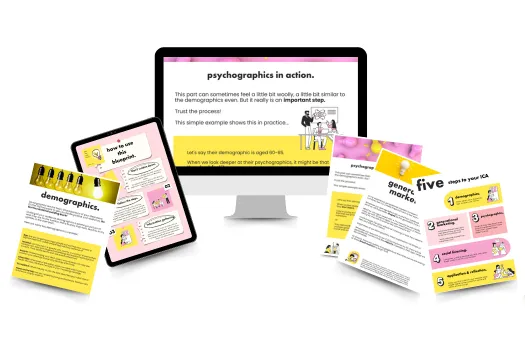
If you'd like to work through your ideal client avatar properly- demographics, psychographics, generational markers and all- I've put together a guide that takes you through it layer by layer. You can download it for free here:
