
INSTAGRAM STORIES EXPERIMENT
2 weeks | 51 stories
What worked (and what didn’t) when we tested two weeks of Instagram Stories- including real data, audience behaviour patterns, and key takeaways you can apply to your own account.
TL;DR:
This was the first Sheldon Social quarterly experiment. With the help of AI I’ve summarised it for you… although I did stop at when it told me the report ‘looked great’! So here’s a briefer text over view…
I tested Instagram Stories for two weeks to see what actually connects right now. Behind-the-scenes and personal content worked best; Canva-heavy posts and early CTAs led to higher exits. Patterns turned out to be more useful than raw numbers.
If you want the deeper dive, graphs, and examples, grab the full experiment report. It has a one-page roadmap at the end for running your own test.
What this experiment was.
In April 2025, I ran a two-week Instagram Stories experiment to see what was really working for Sheldon Social. Not what worked six months ago. Not what I tell clients. What performs when it’s actually me posting. For me. We all get in the rut of doing the same thing, and I wanted some data.
I posted 51 Stories over 15 days during a period when I wasn’t really working. Some were structured; some were spontaneous. The goal was to track real behaviour patterns: reach, taps, exits, forwards, replies.
This wasn’t about perfect strategy, definitely not! It was about seeing what I could actually post and keep posting when life and work were happening at the same time.
How I structured it.
I used three starting content themes: Value, Connection, Engagement.
As I posted, more categories naturally showed up. I tracked them all so I could see what was actually happening, not what I assumed would happen.
Some examples used:
Platform news
Personal insight
Behind-the-scenes
Nostalgia
Tools
Life update
Thought leadership
Education
Email-led
Promotion
Conversation
Strategy
Batching
I used a mix of planned posts and totally ‘on-the-go’ moments. Real photos, screenshots, and some Canva slides. ChatGPT helped me map and categorise everything, and I shared screenshots each morning so it could log and analyse patterns.
What worked.
The top performer was a simple phone photo of a pastry and tea in a pub. It reached 516 people. Most of that came from a repost by the venue, so great for reach, but not necessarily ideal-client aligned. A good reminder about reach and the right audience.
Other Story themes that consistently did well:
Personal downtime and lifestyle
Nostalgic moments
Behind-the-scenes business decisions
Quiet travel and work updates
Real photos taken casually performed best. Light context helped people stay with the Story, and they felt better to watch.
Even Stories with low reach still mattered. One Map. Make. Matter. Story got only 14 views but drove a DM that opened a strategy conversation- so it did its job.
What didn’t work.
Carousel-style Canva slides and text-heavy designs under-performed. Boo!
High exits happened when:
CTA links were added too early
Story groups were posted without intro context
Heavy text appeared without a visual hook
Taps-forward dominated across most Stories. Replies were low, suggesting DM prompts didn’t land.
Even though Canva-first slides didn’t perform on reach, they still served a purpose: thought leadership, positioning, and demonstrating skill. The goal then isn’t reach. It’s the right people paying attention.
Behaviour patterns.
This experiment confirmed what’s being echoed more broadly from people online:
Stories are getting less reach for many creators
Links often suppress views
Polished visuals don’t necessarily perform better
Patterns mattered more than the numbers:
Some Stories had 14 views, some 516, but the difference helped highlight what connects.
Screenshots of emails or posts did okay, usually mid-range.
Video was lightly tested, but a single Reel hit 193 reach and 5 likes, showing promise for moving forward.
Content journey roles.
Every Story was mapped against the customer journey:
Awareness
Nurture
Consideration
Decision
Advocacy
Most Stories sat in Nurture. That makes sense, since Stories primarily reach existing followers.
Big takeaway: Not every platform needs to do everything. Stories played a strong mid-journey role. That shapes future strategy.
Format and visual insights.
Phone-shot photos consistently beat Canva slides.
Minimal context plus a real photo held attention best.
Yellow and pink Canva slides consistently underperformed unless paired with a personal touch.
If you’re using Stories as part of a broader system:
Add context to slide sets to reduce exits
Real photos feel more natural and often perform better
Use CTAs thoughtfully
Strategic outcomes.
This experiment reminded me that sustainable visibility matters more than rigid structure.
Stories that feel natural to post are easier to sustain and often connect more.
Frameworks are helpful, but they need to flex with your energy, capacity, and audience.
This test also gave me the idea to run quarterly experiments and share the results as mini white-papers. They give us owned data we can use with clients, and help us adapt as platforms shift.
Next up for Q3: a LinkedIn sharing strategy experiment. Small commitment, busy life, real insights.
Run your own experiment.
The full report includes a one-page roadmap, but here’s a quick version:
Choose a test window
Set your focus
Pick your content types
Track performance
Mix formats
Try different CTAs
Look for patterns
Reflect and repurpose
Let it be messy
Patterns are where the strategy lives.
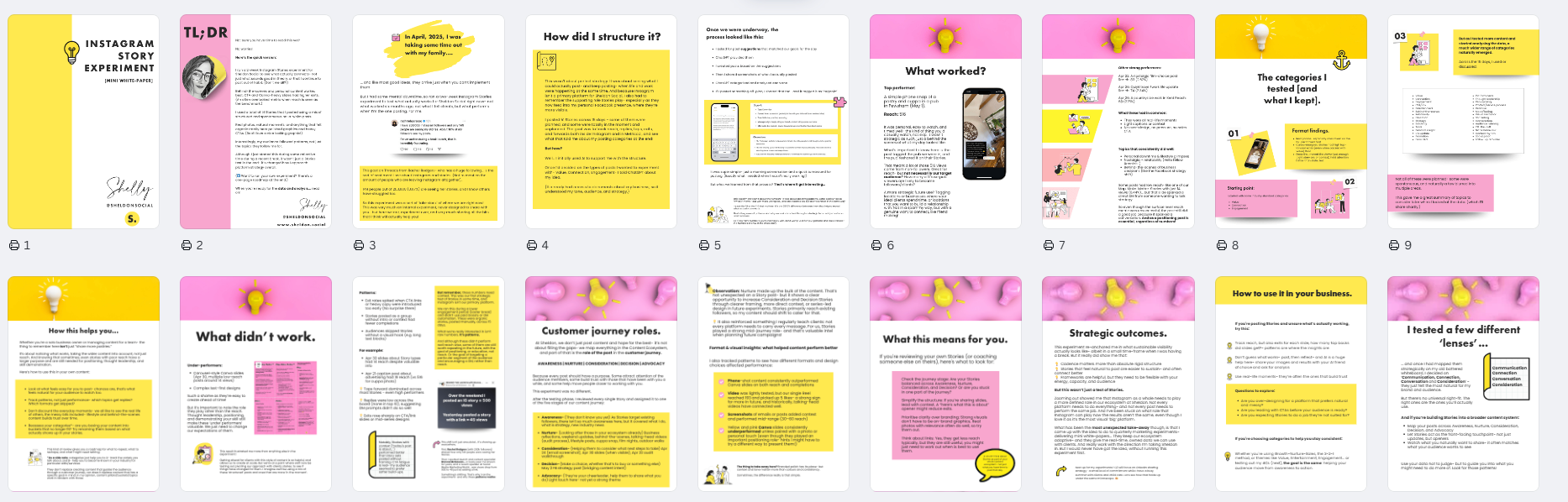
If you want the step-by-step, screenshots, breakdowns, and data visuals, download the full report. It’s the best way to see what this actually looked like day-to-day.
Download the full report.
If you skim this page and think, yes, I want more detail, the full PDF will be super helpful. It has screenshots, examples, and a one-page roadmap if you want to try your own Stories experiment.