
YouTube reinvention!
Testing both long-form and short-form videos to see what happens when you bring consistent posting back to an unloved YouTube channel. Does strategic posting and a clear ecosystem approach revive visibility and engagement on the platform?
[Download your copy of the report if you’d like it to come back to- or read the article below.]
Download the report
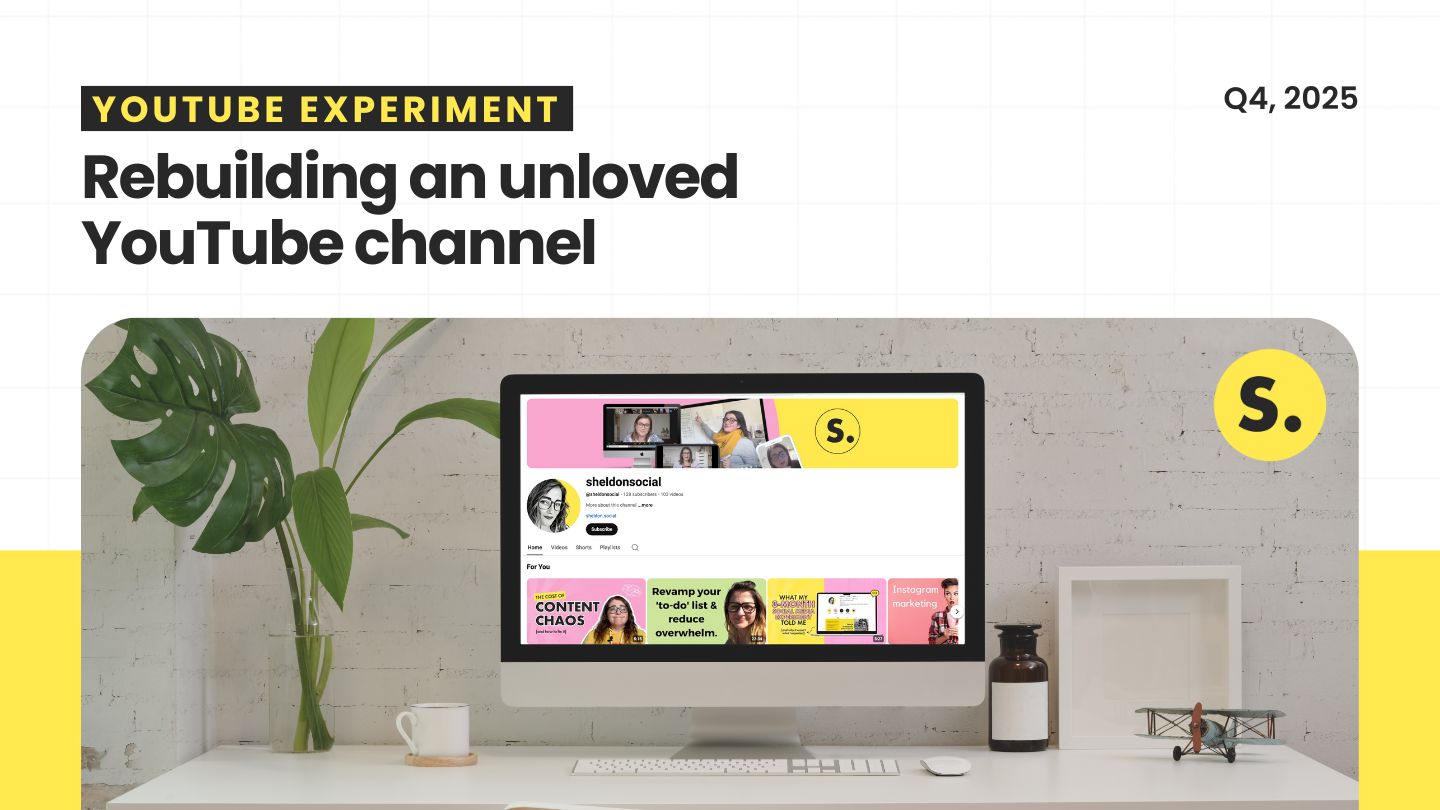
YouTube experiment.
Rebuilding an unloved YouTube channel
Q4, 2025
TL;DR
Over 3 months, consistent posting on YouTube led to:
11.6K+ views
21.2 hours of watch time
15 new subscribers
Almost all discovery came from Shorts.
Long-form played a different role entirely.
The biggest lesson wasn’t ‘post more’ - it was understanding what each format is actually for, and how consistency helps YouTube relearn who you are.
What this experiment was testing?
This Q4 experiment ran from 14 September to 14 December 2025 and focused on one main question:
What happens when you show up consistently on YouTube again - without chasing trends, virality, or forcing weekly long-form content?
My YouTube channel isn’t new, it’s actually been bumbling around since 2017. Historically I’ve used it to host course content when I ran my membership, was sporadic at posting publicly at best! So to say it was quiet is a bit of an understatement!
It hadn’t had regular attention, and certainly hadn’t been treated as part of a wider content ecosystem.
But my quarterly experiments gave me a chance to see if we could fix it!
I posted a mix of:
Short-form video (Shorts)
Long-form video
The goal wasn’t to ‘win YouTube’… I didn’t have the time needed to really ignite that kind of growth… But I could create enough to observe how the platform responds when I post consistently. And by that I mean a few times per week.
Action step:
If your YouTube channel feels stale or neglected, don’t start by redesigning everything. Start by showing up consistently for a defined period and watch how the platform responds before changing your approach.
The Results
Across the 3-month window, the channel saw:
11.7K+ views
21.2 hours of watch time
15 new subscribers
Publishing volume:
26 Shorts
8 long-form videos
This matters because the results didn’t come from high output. I would have loved to test daily, but it just didn’t work out like that for Q4.
I didn’t go in for aggressive batching (like I plan to do for the Q1 experiment in January 2026) and definitely no attempt to ‘game’ the algorithm.
The growth came from enough consistency to give YouTube data about my brand again.
Action step:
Instead of asking ‘how often should I post?’, try asking ‘what’s the minimum consistency I can commit to for 8–12 weeks?’ What can you actually do?! and use that as your experiment window.
Short form vs. long form
What did what?
This is where the data gets interesting. I posted more shorts than long form, a ratio of:
99.4% of views came from Shorts
0.6% came from long-form
14 of the 15 new subscribers came from Shorts
Shorts clearly acted as the discovery engine.
Shorts revived reach, introduced the channel to new people, and triggered YouTube’s distribution.
What’s important to note here is that long-form made up 21% of the video quantity, but only brought in 0.6% of the views. It didn’t fail of course, it wasn’t designed to do the same job - I have long-form videos for thought leadership and positioning, telling our brand narrative… BUT, if you’re using them for reach - test, test, test. Because if your goal IS reach, you’ll need to work out the format that is best for you.
Action step:
If growth is your immediate goal, start by testing short-form. Your long-form will likely support trust, depth, and authority rather than expecting it to drive reach on its own. BUT as always, test, as you may find different results.
How viewers actually found the content
Traffic sources during the experiment were dominated by the Shorts feed:
94.2% Shorts feed
Small percentages from search, channel pages, and browse features
This tells us YouTube wasn’t relying on search intent or subscribers. It was actively testing content in the Shorts ecosystem. I did optimise all my captions for search, and would still recommend you do to, but it’s interesting to see that the shorts feed did a lot of the distribution work!
For an ‘unloved’ channel, this is actually really helpful.
Action step:
When most of your reach is coming from the Shorts feed, the job of the video is to make it easy for your audience to understand, and to give people a reason to keep watching. You can help this by:
One clear idea per video
A strong opening line in the first second (probably don’t start with ‘hi guys’)
No long setup or backstory
Audience behaviour
Almost everyone was new
During the experiment:
99.5% of viewers were new
Very few were casual or regular viewers
This is a signal that YouTube was still learning who to show the content to. It also might have meant that old subscribers were not so engaged with the new content and it wasn’t shown to them.
At this stage, it seems the platform wasn’t worried about loyalty, it was all about new peeps!
Action step:
Use repetition on purpose. Repeat themes, formats, and phrasing so new viewers start to recognise you when they see another video, even if they don’t subscribe straight away.
What content performed best (and why)
The strongest Shorts shared a few consistent traits:
Opinion-led or myth-busting
Clear, practical, and specific
Strategy-focused rather than trend-led
Top performers included:
Why we don’t use bold or italics in posts
The myth about posting daily
Strategic ways to repurpose your content
One video in particular - Strategic ways to repurpose your content - was more likely to bring new viewers back again.
That suggests two different content jobs were happening:
Some content earns attention
Some content builds return behaviour
Action step:
When planning content, deliberately mix:
‘Attention’ posts (hot takes, myths, mistakes)
‘Return’ posts (frameworks, processes, repeatable teaching)
[FYI, AI was a great help with looking at the data and looking at the topics in my titles - using AI to summarise the data might help you see patterns that you might miss.]
Long-form video
A different role entirely
Long-form performance during the experiment:
75 views
1.1–1.2% CTR
Average view duration under 2 minutes
On the surface, that looks underwhelming, and a little ego-bruising - but the context matters. These videos weren’t attached to lead magnets, services, or a clear journey… they existed inside a Shorts-led experiment, not as strategic assets.
That changed how I think about long-form completely.
What this highlighted for me was that long-form video doesn’t work well, at least in my case, when it’s treated as just another slot in the calendar. Without a clear role, it becomes content that exists because it should, not because it actually needs to.
And when that happens, it’s no surprise that it struggles to gain traction or hold attention.
Long form needs context. It needs a reason to exist beyond filling a weekly gap. Even if that reason is a series. Or a regular show. When it’s created with a clear purpose to explain, support, teach or anchor something bigger, it becomes far more valuable, both to the audience and to the wider content ecosystem.
Action step:
Instead of forcing weekly, or regular long-form asset, create long-form when:
It supports a lead magnet
It explains a core concept
It answers a question you keep being asked
It’s something you want referenced for months or years
It’s a piece of intellectual property, or a core asset you can refer your audience back to
It’s a series or has a show like structure, that will likely snowball over time
An unexpected (but important) lesson about quotas
Trying to stick to a fixed posting quota changed my behaviour.
I found myself holding back relevant or reactive content because I’d “already posted enough” that week. The focus shifted from what would help my audience to what fit the schedule.
That was a useful reminder!
And I did know that… in fact, when we do our proposals for clients I avoid giving content quotas where I can, because it actually doesn’t serve the client. But I’d fallen into the trap here of thinking about the frequency for the experiment.
Action step:
Use cadence as a guide, not a rule. Consistency matters of course - it helps your audience to know when to expect to hear from you, and when the check in for new content - but relevance should always come first.
The bigger strategic takeaway
This experiment reinforced something I’ll carry forward:
Short-form builds visibility and familiarity through repetition.
Long-form builds authority, trust, and depth - when created intentionally.
They do different jobs, and treating them the same usually leads to frustration.
I need to create both, but for different reasons, and in different quantities.
Action step:
When planning content, be clear on the job each piece is meant to do. If you don’t know its job, the platform probably won’t either.
What I’ll test next (and what you might try too)
The data points clearly to the next step: turning new viewers into returning ones.
That’s why the next experiment (although designed for TikTok, will also be great for shorts) will focus on a bingeable Shorts series, where repetition and format do the relationship-building work, and encourage those repeat visitors.
Action step:
If you want to test this too:
Pick one theme
Turn it into a short series
Keep the structure consistent
Post it over 4–6 weeks
Track returning viewers, not just views
We’ll look at the momentum, and whether the views go up over time, and whether the returning viewers happen too!
Checklist
How to apply this to your own business
Commit to a defined experiment window (8–12 weeks)
Use Shorts for discovery, not perfection
Repeat formats so viewers recognise you
Mix attention-earning and trust-building content
Treat long-form as an asset, not a quota
Let relevance override rigid posting schedules
Measure returning viewers, not just reach
What to test next
This experiment is part of an ongoing series where we test platforms, formats, and strategie- over time, with real data.
If this was useful, you might want to:
Explore our other experiments
See what we’re testing next
Or use these insights to inform your own content decisions
We share all current and past experiments on the website, alongside our tools, frameworks, and resources.
https://www.sheldon.social/quarterly-experiments
Next step:
Visit the experiments page to explore what we’re testing now and what’s coming next.